
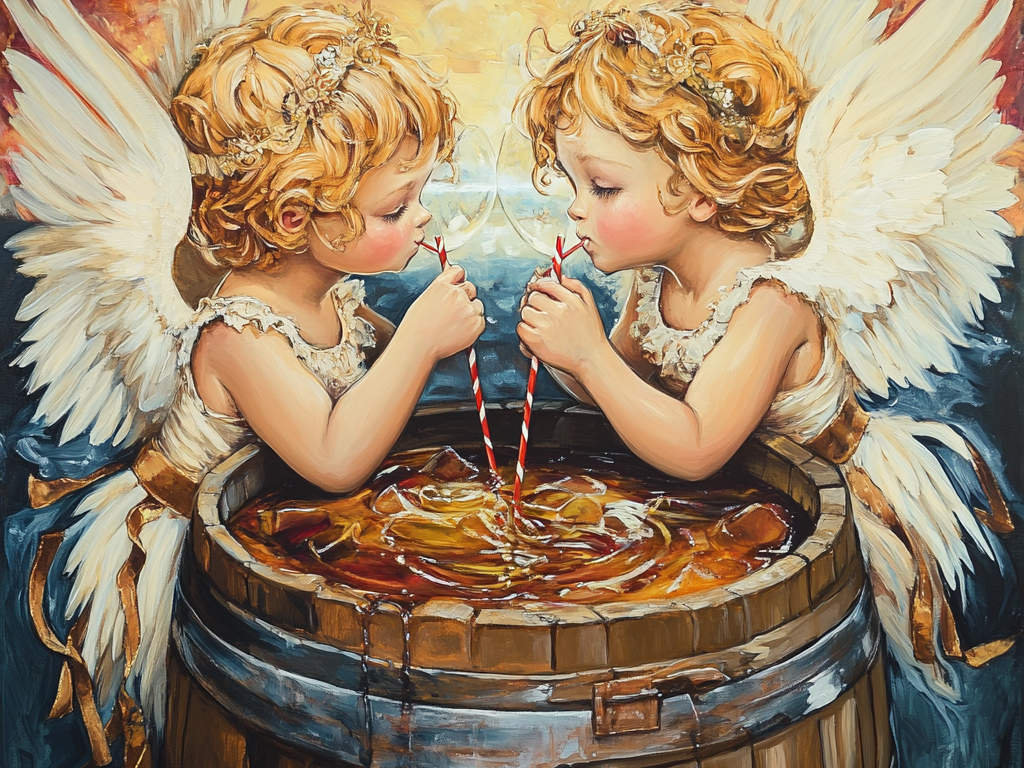
A Battle of Boozy Ghosts
Ever wonder why your rum (or whiskey) seems to vanish during aging? It’s not just the wood barrels playing a trick on you—it’s a phenomenon known as the Angel’s Share. Romantic, right? But depending on where in the world your rum is aging, it might not be angels taking a cut at all… it could be something a little more mischievous.
The Angel’s Share: Where Do the Spirits Go?
So, here’s the deal: as rum (or any spirit) sits in its cozy oak barrel to age, a portion of it—typically 2-10% per year—evaporates into thin air. This evaporated portion is known as the Angel’s Share, a whimsical nod to the idea that these unseen celestial beings are getting their cut of the goods. Because let’s face it, if you’re an angel, what better gig is there than floating around a distillery, sipping on premium rum?
But it’s not all fun and games—this evaporation plays a key role in shaping the final flavor of the spirit. Oak barrels are porous, allowing a slow exchange of air and liquid that softens and adds complexity to the rum. So while the angels might be having their share, we’re left with an aged spirit that’s richer, deeper, and far tastier.
The Duppy’s Share: Caribbean Spirits with a Twist
But head over to the Caribbean, and you’ll find that it’s not angels sneaking off with your rum—it’s duppies. In Caribbean folklore, duppies are ghostly spirits, and they’ve earned a reputation for being troublemakers. So naturally, when rum mysteriously evaporates in Caribbean distilleries, it’s these mischievous spirits stealing their share.
The Duppy’s Share is essentially the same as the Angel’s Share—just with a more spooky, cultural twist. Given the Caribbean’s rich history of folklore and storytelling, it’s no surprise that the blame falls on these supernatural tricksters rather than benevolent angels.
Angels vs. Duppies: What’s the Real Difference?
Not much, really. Whether it’s angels or duppies, the science behind it is the same. Both terms describe the evaporation that occurs as rum ages in oak barrels. In colder climates, like Scotland or the U.S., evaporation tends to be slower (think 2-5% per year), but in the warm, tropical Caribbean, the heat accelerates evaporation, meaning more is lost to those thirsty duppies (often closer to 10% annually).
But here’s where it gets interesting: the environment affects not just how much evaporates but also how the spirit ages. Warm climates like those in the Caribbean speed up the aging process, meaning your rum develops those delicious oak and spice notes more quickly than a whiskey sitting in a chilly Scottish warehouse.
So, the next time you sip on a perfectly aged rum, whether it’s been under the watchful eyes of angels or chased by duppies, just remember—it’s not just the barrel doing the work. Somewhere out there, a spirit’s gotten a free drink.
 The Rumosphere